
VERIFIED NEWS · INTERIM FINAL RULE
DHS expands permanent-residence registration rule for certain U.S.-born children
The rule broadens an existing permanent-residence registration framework. Its practical implementation is limited by a federal injunction, and the public-inspection document is scheduled for formal Federal Register publication September 9.
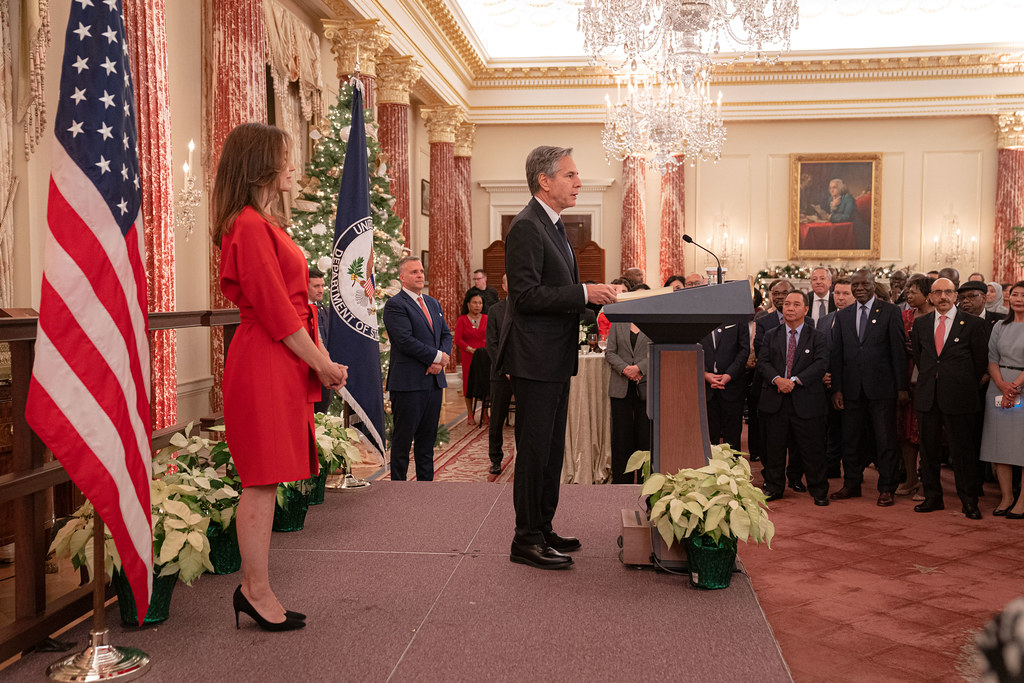
State Department photograph by Freddie Everett, published December 8, 2022; public domain. It shows a diplomatic-corps reception in Washington. This official government image is illustrative and does not depict affected parents, children, a USCIS decision, the federal lawsuit, or implementation of the 2026 rule. Original State Department photograph ↗
What the rule changes
DHS amended regulations that previously addressed children born in the United States to foreign diplomatic officers. The new text uses a broader category—“foreign government employee”—and permits certain children covered by that category who are not U.S. citizens to register voluntarily as lawful permanent residents. DHS also revised references connected to Forms I-485 and G-325R.
Who the new definition covers
The rule lists accredited foreign diplomatic officers; nationals of a foreign country employed by that country’s embassy or consulate; people employed by a foreign government in an official capacity; and employees of qualifying international organizations with immunity. It also lists exclusions, including certain personal employees, third-country nationals working for a foreign government, and foreign-government employees visiting in a personal capacity.
The change is prospective
The public-inspection text says the rule applies to children born on or after its effective date. Children born before that date are treated under the regulations in place at the time of birth. The rule states that permanent-residence registration under this provision is voluntary; it separately discusses federal alien-registration requirements.
A court injunction limits implementation
DHS says a September 2 preliminary injunction in Casa Inc. v. Trump prevents the department from implementing the rule against members of the certified class or otherwise conflicting with the order unless the government obtains relief. That is litigation affecting implementation—not a repeal of the rule, a final merits judgment, or a new regulation.
The affected population is not quantified
DHS cites more than 124,000 foreign-mission members and dependents hosted in the United States, but expressly says that figure cannot estimate the rule’s affected population. Available data do not identify several necessary factors, and USCIS has not historically tracked the new group separately. The figure therefore is not a count of affected children.
Primary federal sources
- Federal Register public-inspection document, filed September 4 ↗
- USCIS announcement, September 4 ↗
- Federal Register document-status page ↗
Corrections: No corrections have been made. The article will distinguish the scheduled published version and any later court order or agency action when verified.